What Is a Magnetometer?
The Simple Definition
A magnetometer is an instrument that measures the strength and direction of magnetic fields. Think of it as a thermometer, but instead of measuring temperature, it measures magnetism.
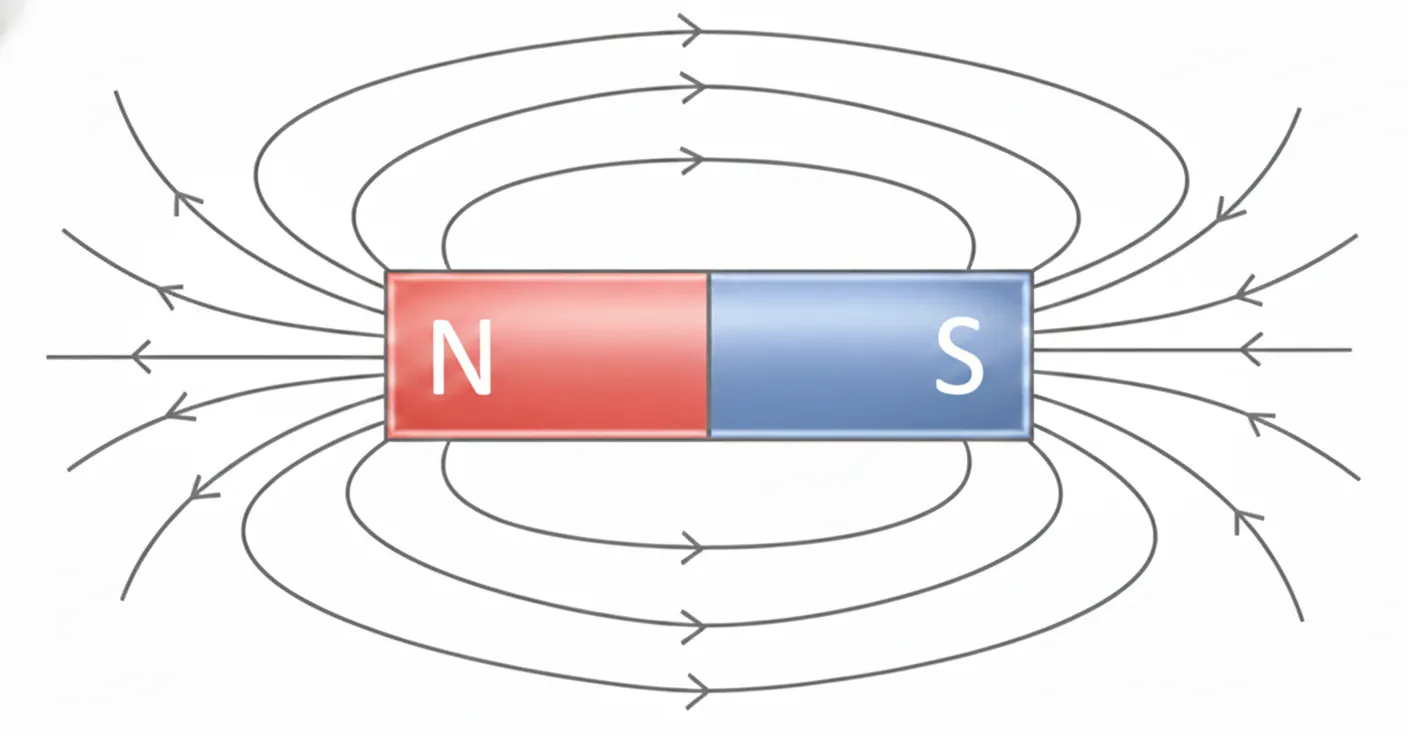
Magnetic fields are invisible forces that surround magnets, electrical currents, and even our entire planet. A magnetometer makes these invisible fields visible and measurable — turning something you can't see or feel into a precise number.
The word comes from combining "magneto" (relating to magnets) with "meter" (a measuring device). Simple enough — but the technology behind it ranges from ancient compasses to quantum-mechanical sensors that can detect fields a billion times weaker than Earth's.
What Do Magnetometers Actually Measure?
To understand what a magnetometer does, you first need to know what a magnetic field is. Every magnet — from a fridge magnet to the Earth itself — creates an invisible field around it. This field has two properties:
- Strength (magnitude) — How intense the field is, measured in units like tesla or gauss
- Direction — Which way the field lines point in 3D space
Some magnetometers measure only the total strength (these are called scalar magnetometers). Others measure both strength and direction along specific axes (these are vector magnetometers). The magnetometer in your smartphone is a vector type — it measures the field along three perpendicular axes (X, Y, Z).
The Magnetometer in Your Pocket
Here's something that surprises most people: your smartphone already contains a magnetometer. Every modern smartphone includes a tiny chip called a 3-axis Hall effect sensor (or sometimes a magnetoresistive sensor) that measures the magnetic field along three perpendicular directions.
Apple added a magnetometer to the iPhone starting with the iPhone 3GS in 2009 — originally just to power the Compass app. That same tiny sensor can detect hidden metal objects, measure the Earth's field, and even identify electromagnetic interference.
Your phone's magnetometer is what makes the compass app work. It detects Earth's magnetic field to determine which direction is north. But with the right app, that same sensor becomes a powerful scientific instrument capable of:
- Detecting metal objects behind walls (studs, pipes, rebar)
- Measuring magnetic field strength in microtesla
- Recording magnetic field data over time
- Identifying sources of electromagnetic interference
- Conducting physics experiments and field surveys
The sensor itself is incredibly small — about the size of a grain of rice — and draws almost no power. It works by measuring tiny voltages created when a magnetic field passes through a semiconductor material (this is the Hall effect, which we cover in detail in the next chapter).
How Sensitive Is a Smartphone Magnetometer?
A typical smartphone magnetometer can detect fields from about 1 microtesla (µT) up to several thousand microtesla. Earth's magnetic field is roughly 25-65 µT depending on your location, so smartphone sensors are well within range for measuring it.
For reference, a small fridge magnet produces about 5,000 µT (5 millitesla) at its surface, and an MRI machine generates fields of 1.5 to 3 million µT (1.5-3 tesla). While a smartphone can't measure an MRI field directly (it would saturate the sensor), it's perfectly suited for everyday magnetic field measurements.
Quick Overview of Magnetometer Types
Not all magnetometers work the same way. There's a whole family of sensors, each designed for different sensitivity ranges and applications. Here's a quick preview (we go deep on each type in Chapter 4):
| Type | How It Works | Found In |
|---|---|---|
| Hall Effect | Voltage from a semiconductor in a magnetic field | Smartphones, automotive sensors |
| Fluxgate | Saturating a ferromagnetic core with AC current | Geophysical surveys, navigation |
| Proton Precession | Measuring spin frequency of hydrogen protons | Geological surveys, archaeology |
| SQUID | Quantum tunneling in superconducting loops | Medical imaging, physics labs |
| Optically Pumped | Atomic vapor excited by laser light | Space missions, military |
Who Uses Magnetometers?
Magnetometers show up in more places than you might expect:
- Geologists — Map underground rock formations and mineral deposits by detecting magnetic anomalies
- Archaeologists — Find buried structures, kilns, and artifacts without digging
- Navigation systems — Every aircraft, ship, and smartphone compass relies on magnetic field sensing
- Space agencies — Map planetary magnetic fields and monitor solar wind
- Doctors — Magnetoencephalography (MEG) uses ultra-sensitive magnetometers to measure brain activity
- Homeowners — Detect studs, pipes, and wiring behind walls using a smartphone
- Military — Detect submarines, mines, and vehicles from their magnetic signatures
- Physicists — Study magnetic properties of materials and fundamental physical constants
We explore all of these applications in depth in Chapter 6: Applications.
Key Terms to Know
Before diving deeper into the following chapters, here are the essential terms you'll encounter:
| Term | Meaning |
|---|---|
| Magnetic field | An invisible force field created by magnets, electrical currents, or moving charged particles |
| Tesla (T) | The SI unit of magnetic field strength. Earth's field is ~50 microtesla (µT) |
| Gauss (G) | The CGS unit. 1 tesla = 10,000 gauss. Often used in industry |
| Scalar magnetometer | Measures only the total strength of the field (not direction) |
| Vector magnetometer | Measures the field along individual axes (X, Y, Z), giving both strength and direction |
| Ferromagnetic | Materials (iron, steel, nickel, cobalt) that produce strong magnetic fields and are strongly attracted to magnets |
| Magnetic anomaly | A local variation in the magnetic field caused by a nearby magnetic object or geological feature |

You can turn your iPhone into a working magnetometer right now. Magnetometer X gives you real-time magnetic field readings with three specialized modes — from a simple gauge to full scientific data logging with CSV export.