Earth's Magnetic Field
The Invisible Shield
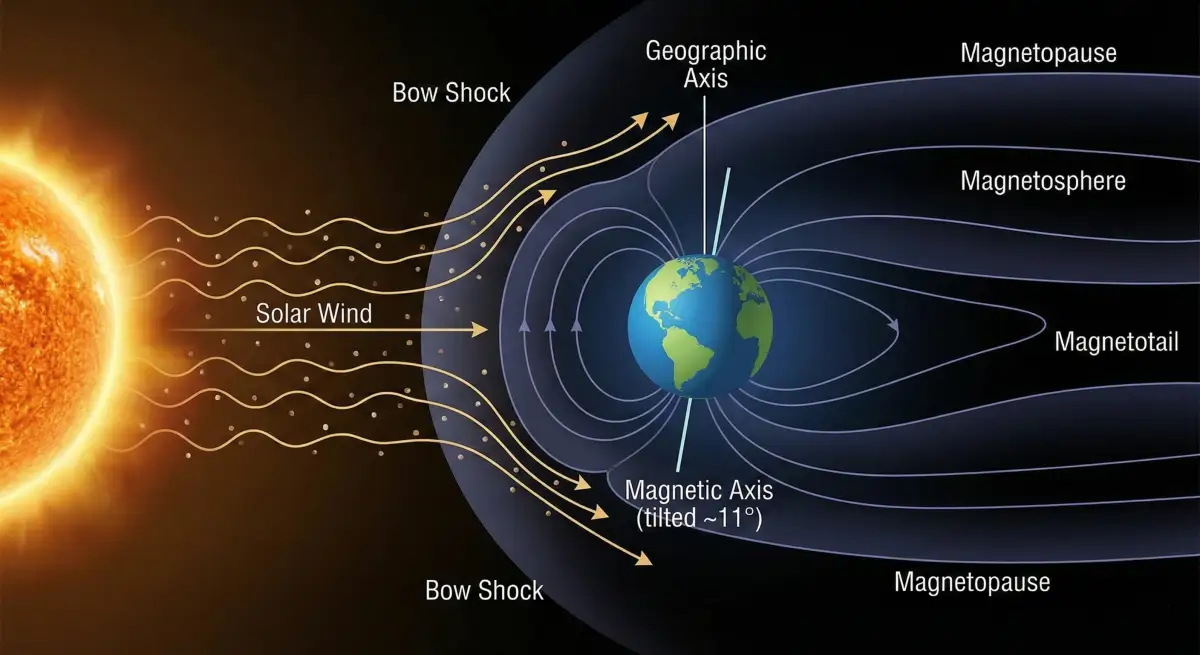
Earth is surrounded by an enormous magnetic field called the magnetosphere. This invisible force field extends tens of thousands of kilometers into space and plays a critical role in making our planet habitable.
Without the magnetosphere, the solar wind — a constant stream of charged particles from the Sun — would strip away Earth's atmosphere over time, much like it stripped away Mars' atmosphere billions of years ago. Earth's magnetic field deflects most of these particles, channeling some toward the poles where they create the aurora borealis (northern lights) and aurora australis (southern lights).
What Generates It? The Geodynamo
Earth's magnetic field is generated by the geodynamo — a natural dynamo powered by convection currents in Earth's liquid iron outer core, about 2,900 km below the surface.
Here's the basic mechanism:
- Heat from the inner core drives convection currents in the liquid iron outer core
- Earth's rotation (Coriolis effect) organizes these currents into spiral patterns
- The moving liquid iron (an electrical conductor) generates electrical currents
- These electrical currents create magnetic fields
- The magnetic fields reinforce the currents in a self-sustaining feedback loop
The geodynamo has been running for at least 3.45 billion years — we know this from magnetic minerals in ancient rocks. That makes Earth's magnetic field almost as old as life itself.
Components of the Field
Geophysicists describe Earth's magnetic field at any point using three components:
Declination (D)
Magnetic declination is the angle between magnetic north (where your compass points) and true geographic north. This angle varies dramatically depending on your location — from near zero in some places to more than 20° in others.
For example, in parts of the eastern United States, a compass needle points about 10-15° west of true north. In Alaska, the declination can exceed 20°. Navigators must account for this when using magnetic compasses.
Inclination (I)
Magnetic inclination (or dip angle) is the angle the field makes with the horizontal surface. At the magnetic equator, field lines are nearly horizontal (inclination ~0°). At the magnetic poles, field lines point straight down into the Earth (inclination ~90°).
If you held a magnetized needle perfectly balanced on a pivot at the North Pole, it would point straight down. At the equator, it would lie flat. At mid-latitudes, it dips at an intermediate angle.
Intensity (F)
Total field intensity is the overall strength of the magnetic field at a given point. It ranges from about 25 µT near the equator to about 65 µT near the poles.
The intensity can be broken down into a horizontal component (H) and a vertical component (Z), which relate to the total field by: F² = H² + Z².
Magnetic Poles vs. Geographic Poles
One of the most confusing things about Earth's magnetism: the magnetic poles are not at the geographic poles.
The magnetic north pole (where your compass points) is currently located in the Canadian Arctic, about 500 km from the geographic North Pole. And it moves — the magnetic north pole has been drifting toward Siberia at about 40-50 km per year in recent decades, faster than at any time in recorded history.
Strictly speaking, the "north magnetic pole" is actually a south magnetic polarity — because the north-seeking end of a compass needle (a north magnetic pole) is attracted to it. Physicists know this but the naming convention stuck for historical reasons.
Pole Wander Over Time
Both magnetic poles wander continuously. The north magnetic pole was in the Canadian Arctic for centuries but has been accelerating toward Siberia since the 1990s. Scientists believe this is driven by changes in the iron convection patterns deep in Earth's core.
Field Strength Around the World
Earth's magnetic field is not uniform — it varies significantly with location. Here's how the total field intensity varies across different regions:
Total field intensity values are approximate and vary within each region. The South Atlantic Anomaly is notably weaker than expected.
The South Atlantic Anomaly
There's a large area over the South Atlantic and South America where the field is unusually weak — only about 23 µT, roughly half the normal value for that latitude. This is called the South Atlantic Anomaly (SAA).
In this region, the reduced magnetic shielding allows more cosmic radiation and solar particles to reach lower altitudes. Satellites passing through the SAA sometimes experience glitches, and the International Space Station has extra radiation shielding for this zone. Astronauts sometimes see "shooting stars" in their vision when passing through it — caused by energetic particles hitting their retinas.
Magnetic Reversals
One of the most dramatic aspects of Earth's magnetic history: the poles have swapped places hundreds of times. During a reversal, the magnetic north pole becomes the south pole and vice versa.
- The last complete reversal happened about 780,000 years ago (the Brunhes-Matuyama reversal)
- Reversals happen irregularly — sometimes millions of years apart, sometimes only tens of thousands
- A reversal takes about 1,000 to 10,000 years to complete
- During a reversal, the field doesn't simply flip — it weakens, becomes chaotic with multiple poles, then re-establishes in the opposite direction
- The field drops to about 10-25% of its normal strength during the transition
The average time between reversals over the last few million years is about 450,000 years. It's been 780,000 years since the last one, and the current field has been weakening by about 5% per century. Some scientists think this could be the early stages of a reversal — but it could also just be normal fluctuation. We won't know for thousands of years.
Measuring Earth's Field
You can measure Earth's magnetic field right now with your smartphone. The magnetometer in your phone detects the field in three axes (X, Y, Z), and a magnetometer app will show you the total field strength in microtesla.
Try this experiment: open a magnetometer app and note the reading. Now slowly rotate your phone — you'll see the individual X, Y, Z values change even though the total magnitude stays roughly constant. That's because you're changing which axis "sees" the field, not the field itself.

Open Magnetometer X in Scientific Mode to see the real-time X, Y, Z decomposition of Earth's field. Walk away from electronics and magnetic objects to get a clean baseline reading of just the Earth's field at your location.